

A crypto structured product is a financial instrument that uses a cryptocurrency as its underlying asset, giving investors exposure to digital assets while defining specific return profiles aligned with their risk appetite.
The purpose of a structured product is to deliver customised outcomes that traditional instruments like stocks, bonds, or ETFs cannot easily provide. Stocks and ETFs offer direct market exposure, while bonds provide predictable income but limited flexibility. Structured products combine elements of both, allowing investors to balance protection, yield, and upside potential.
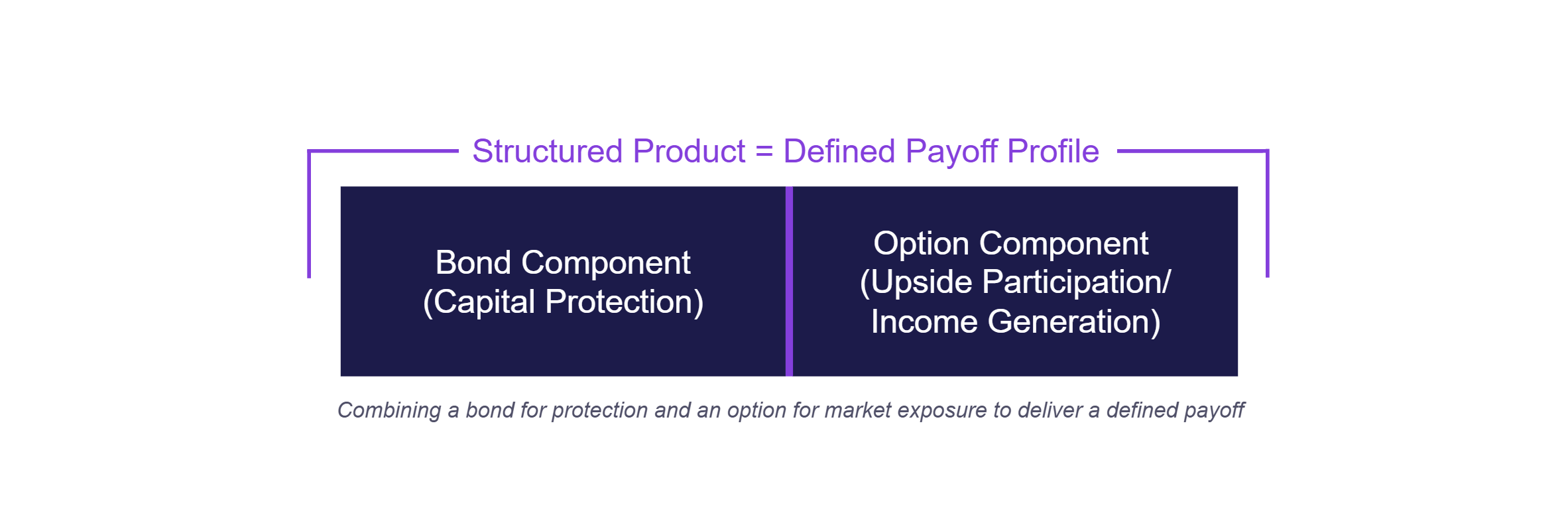
At their simplest, structured products are built from two components: a bond, which underpins capital preservation, and an option, which shapes the payoff by adding upside participation. In more complex structures, they can embed derivatives such as futures, options, or swaps linked to crypto or traditional asset classes, making it possible to customise exposure, limit downside, or enhance potential returns.
In the case of crypto, investors can participate in the asset class without holding wallets or coins directly, but with more control over how much risk they assume and what kind of payoff they target.
(For a refresher on how structured products are built, see Structured Products In Focus: What Are They For?)
What are the different types of Crypto Structured Products?
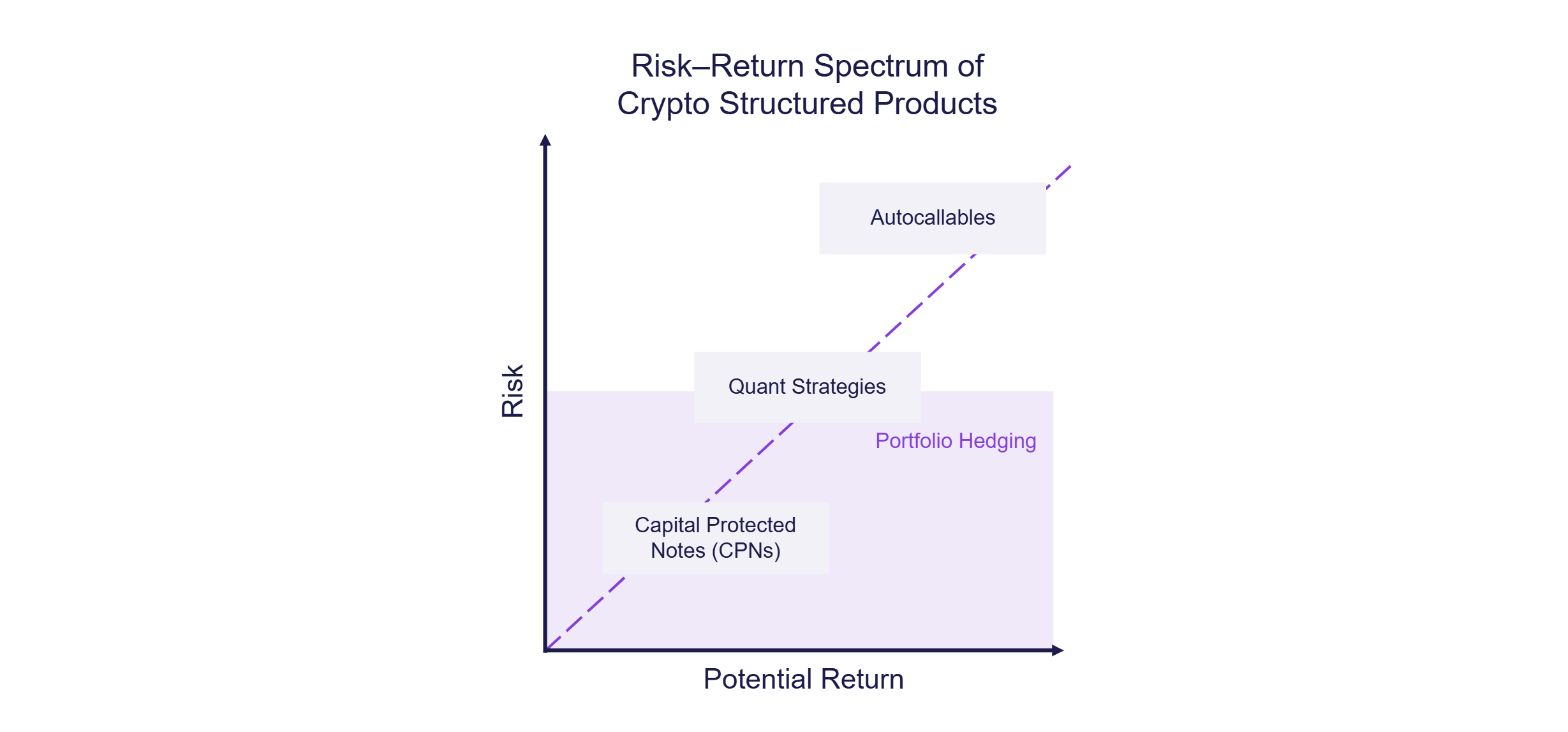
Crypto structured products are designed to meet a range of investment objectives, from generating income to protecting capital or managing volatility. Some of the most common categories include:
- Fixed Yield Strategies – These are aimed at investors who prioritise predictable income. They typically pay a set coupon over a defined period, sometimes with little or no dependence on the direction of crypto prices. This makes them attractive for those who want exposure to the asset class while minimising uncertainty in returns.
- Principal-Protected Notes (PPNs) – Designed for more cautious investors, PPNs safeguard part or all of the invested principal while still offering upside exposure to cryptocurrencies. They are often used as an entry point for those new to digital assets who want to participate in potential gains without being fully exposed to the downside.
- Autocallable Structures – These offer potentially higher yields by paying regular coupons as long as the underlying crypto remains above certain levels. If favourable conditions are met, the product may “autocall,” meaning it ends early and returns capital plus coupons. They appeal to investors willing to take conditional downside risk in exchange for higher returns.
- Quantitative Investment Strategies (QIS) – Sometimes called rules-based strategies, these are algorithm-driven solutions designed to optimise performance across different market conditions. QIS allow investors to access specific investment opportunities, whether long-only (smart beta) or absolute return (risk premia), in a transparent way, without the need to trade the underlying assets directly.
- Portfolio Hedging Solutions – These are used by investors or corporates who already hold crypto assets and need to manage volatility or reduce downside risk. Hedging structures can limit losses in volatile markets, making them a valuable tool for miners, treasuries, or funds that rely on digital assets for revenue or balance sheet strength.
Who might consider investing in a crypto structured product?
Over the last few years, the crypto market has matured beyond short-term speculative trading. More investors, from private individuals to institutions, are now looking for ways to integrate digital assets into broader investment portfolios. One area gaining momentum is crypto-linked structured products, which use tools from traditional finance to manage risk and customise exposure.
- New Market Entrants – Individuals who are new to crypto may use structured products to gain exposure without handling wallets or navigating exchanges. These solutions offer a controlled way to participate in digital-asset markets.
- Institutional Investors & Asset Allocators – Hedge funds, family offices, and pension funds may use structured products to access crypto within structures already aligned to their operational, regulatory, and portfolio-construction frameworks. They also support diversification without requiring direct custody of digital assets.
- Private Banks & Wealth Managers – These institutions can offer clients crypto-linked opportunities through defined-outcome products, without needing deep in-house expertise across trading, custody, or market infrastructure.

Why or How Institutions Use Structured Products in Crypto
As the crypto market has matured, institutional investors are increasingly seeking ways to integrate digital assets into broader portfolios without relying on speculative trading or direct coin ownership. Structured products, long established in traditional finance, now provide a familiar framework for doing so. They allow institutions to define risk parameters and structure return outcomes, diversify exposures, and access the asset class within frameworks they already understand.
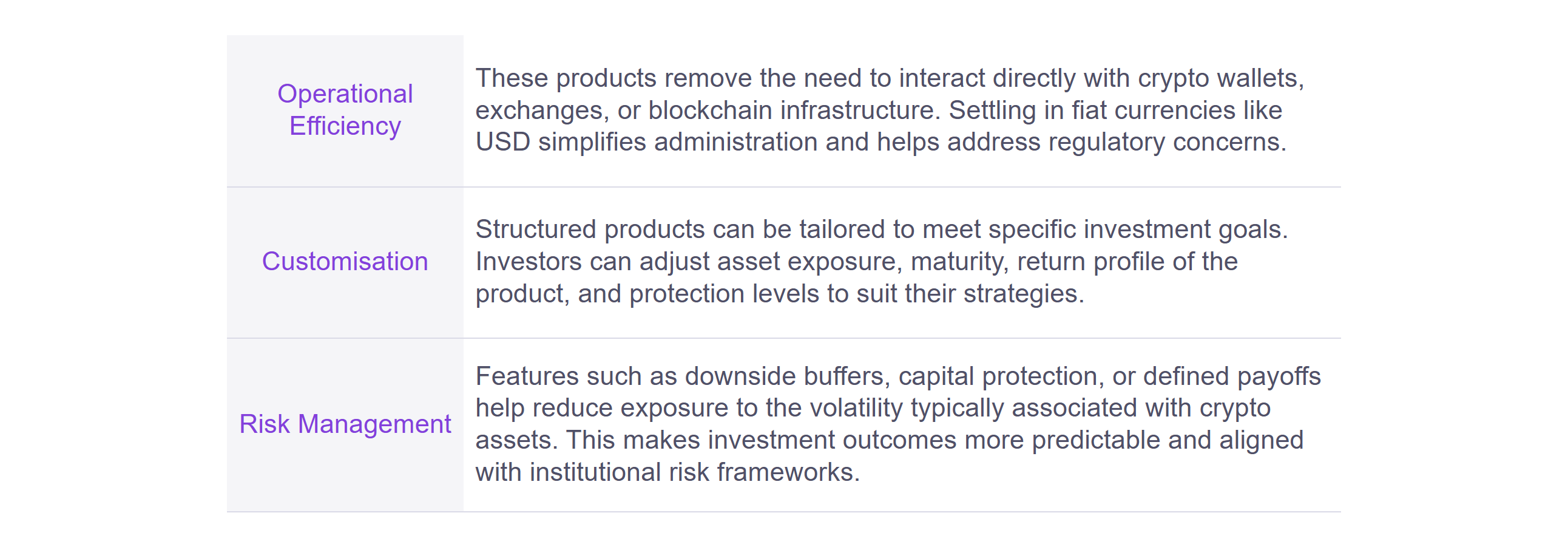
For many institutions, the appeal lies in operational efficiency and risk management. Most crypto structured products settle in USD, avoiding the custody and security challenges of holding tokens directly. At the same time, they can reduce counterparty and credit risk by using established financial market infrastructure. In practice, this means investors can apply proven techniques from equities, rates, and commodities markets to digital assets, gaining exposure through well-defined outcomes rather than simple spot positions.
Key Advantages of Structured Products in Crypto
Structured products offer several advantages that make them especially useful for institutional investors entering or expanding their presence in the digital asset space:
The Bigger Picture
As the crypto market continues to evolve, structured products and crypto derivatives are increasingly being used to support a shift from short-term trading towards longer-term, strategic investment. More institutional investors are exploring alternatives beyond traditional ETFs, seeking solutions that offer greater control over risk and return.
Across the market, there is growing recognition that crypto structured products offer a disciplined way to access digital assets, using familiar frameworks such as defined payoffs, capital protection and transparent pricing rather than speculative exposure. Many issuers now design these products to settle in USD, helping to eliminate the custody and operational challenges that once limited participation.
Education and transparency are also key drivers of adoption. Tools such as digital term sheets, scenario analysis and visual payoff illustrations are helping investors better understand return profiles and risk parameters, supporting broader confidence in the asset class.
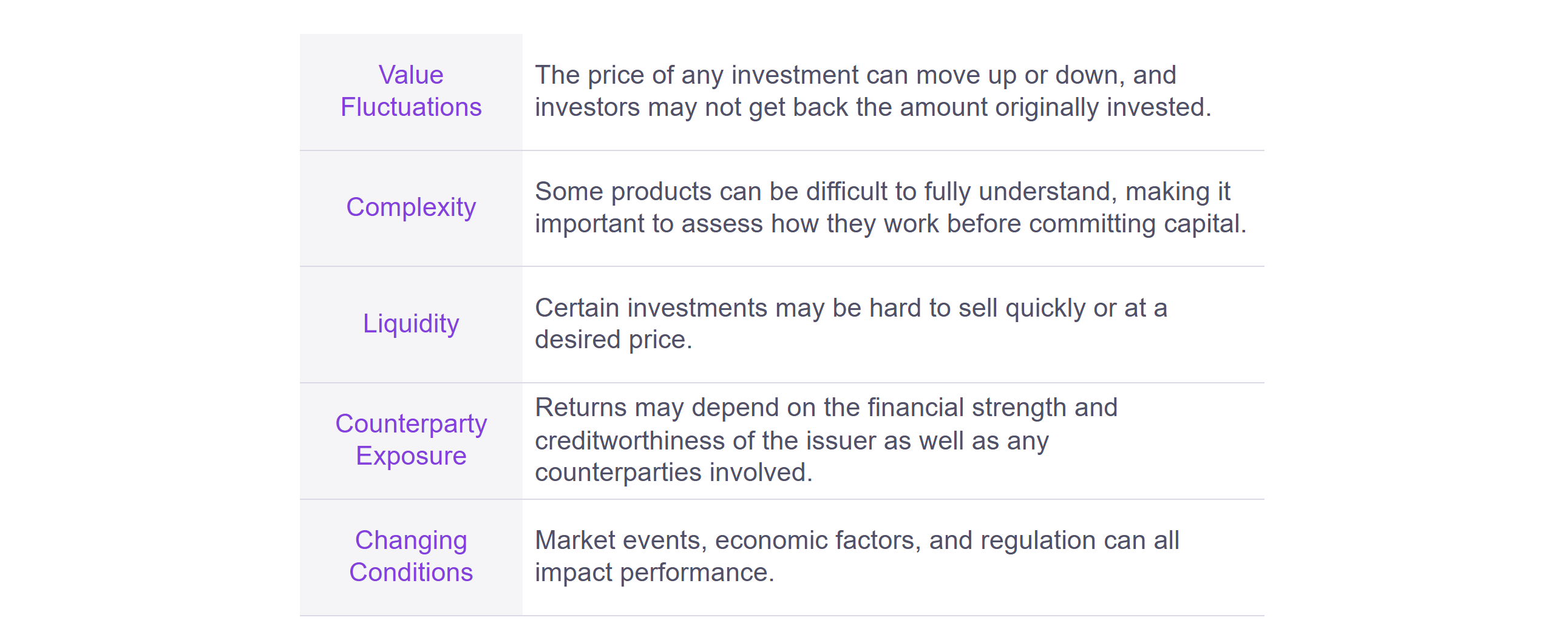
That said, no investment is ever completely risk-free, and this applies equally to crypto structured products. All investments involve the potential for loss, and past performance is not a reliable indicator of future results. Key points to keep in mind include
Crypto structured products continue to play an important role in the market’s maturation, offering a risk-defined, transparent and operationally efficient framework for investors seeking to participate in the digital-asset economy with confidence and control.
If you are interested in understanding more about the types of approaches available for digital asset exposure, our team would be pleased to discuss this with you.
Let’s Talk
This document has been prepared by Marex for information purposes only.
It may not be copied, distributed, published or reproduced in whole or in part without the prior written consent of Marex. Marex does not give any representation or warranty, whether express or implied, as to the accuracy, completeness, currency or fitness for any purpose of use of any information in this document.
Information in this document should not be considered as investment research, investment advice, or as a recommendation, offer or solicitation to purchase or otherwise deal in securities, derivatives, investments or any other products or instruments. The document does not take into account particular investment objectives, risk appetites, financial situations or needs. Recipients of the document should make their own trading or investment decisions based upon their own financial objectives and financial resources.
Any investment strategy described in this document entails a high degree of risk, including the risk of loss. There is no assurance that any investment strategy described in this document will achieve its objective. Any offer or solicitation of any investment product may only be made pursuant to the relevant offering document, which will be furnished to qualified investors on a confidential basis at their request for their consideration in connection with such offering. Such recipients should read and understand all the risks described in the relevant offering document and consult its own legal, accounting and tax advisors as to the legal, business, tax and related matters concerning the information to make an independent determination and consequences of any potential investment.
This document may contain forward looking statements including statements regarding our intent, belief or current expectations with respect to Marex’s businesses and operations, market conditions, results of operation and financial condition, capital adequacy, specific provisions and risk management practices. Readers are cautioned not to place undue reliance on these forward-looking statements which may be subject to change without notice. While reasonable care has been used in the preparation of forecast information, actual results may vary in a materially positive or negative manner. Forecasts and hypothetical examples are subject to uncertainty and contingencies outside Marex’s control. Past performance is not a reliable indication of future performance.
Any indications of past performance are not reliable indicators of future results. Any indications and/or forecasts of future performance are not reliable indicators of future results. Returns may also increase or decrease as a result of currency fluctuations and are impacted by commissions, fees or other charges.
The information contained herein is current as at the date of publication. No part of this document may be redistributed, copied or reproduced without prior written consent of Marex. While reasonable care has been taken to ensure that the facts stated are fair, clear and not misleading, Marex does not warrant or represent (expressly or impliedly) their accuracy or completeness. Any opinions expressed may be subject to change without notice. Marex accepts no liability whatsoever for any direct, indirect or consequential loss or damage arising out of the use of all or any of the data or information in this document.
Additionally for UK investors:
In the United Kingdom (“UK”), Marex only allows access to structured products and derivative products, with cryptoassets as the underlying, and related services to clients who meet the criteria for being categorised as a professional client or eligible counterparty (“ECP”) under the Financial Conduct Authority (“FCA”) rules. This communication is directed at UK investors that are professional clients or ECPs only. Additionally, access to these products and related services are provided by [Marex Financial (FCA registration number 442767), Marex Spectron International Limited (FCA registration number (FCA registration number 442767), Marex Prime Services Limited (FCA registration number (FCA registration number 442744), Marex Capital Markets Inc (FCA registration number 1010404) and/or HPC Investment Services Limited (FCA registration number 776033)] which are each authorised and regulated by the Financial Conduct Authority.
This is a financial promotion which was approved by Marex Financial (“MF”) for the purposes of the UK financial promotions regime. MF is incorporated under the laws of England and Wales (company no. 5613061, LEI no. 5493003EETVWYSIJ5A20 and VAT registration no. GB 872 8106 13). MF’s registered address is at 155 Bishopsgate, London, EC2M 3TQ.